This site uses Cookie to improve site usability. Please read Our Privacy Policy regarding the use of Cookie on our site.

Christopher Rüping "CRAVE" by Sarah Kane
From the cutting edge of Europe, the work of theater maverick Christopher Rüping makes its long-awaited debut in Japan!
Witness how this unconventional masterpiece unearths the enduring relevance of the late Sarah Kane’s texts.
One of the most important directors in the German-speaking theater world, Christopher Rüping presents his work in Japan for the first time. Rüping, whose directing style is characterized by actors frequently addressing the audience directly, crossed paths with Toshiki Okada during their time at the Munich Kammerspiele. His long-awaited invitation to Autumn Meteorite Tokyo was realized thanks to their strong appreciation for each other’s work.
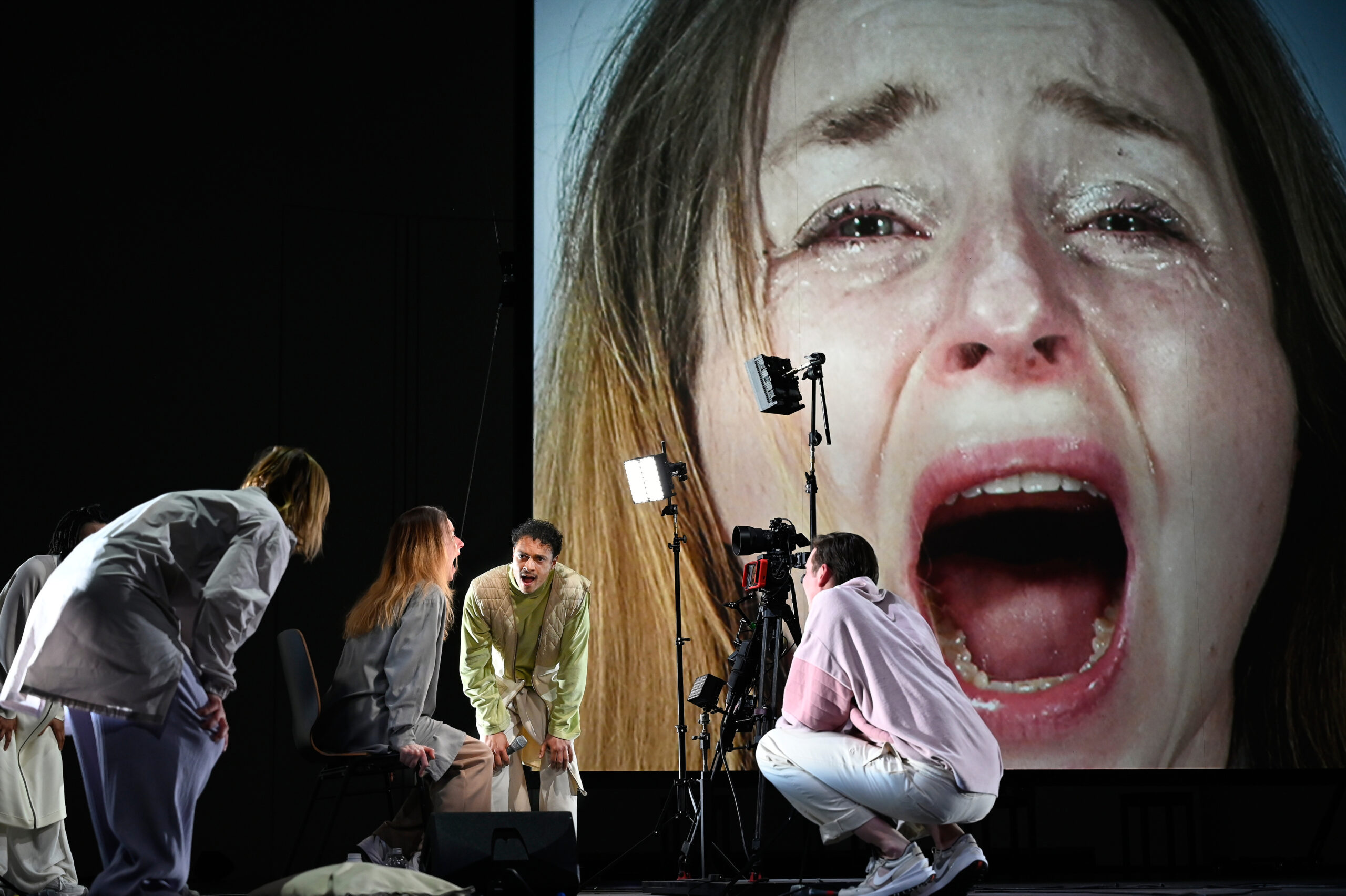
The source material, “Crave” (first performed in 1998), was written by British playwright Sarah Kane, who passed away at the age of 28. Eschewing narrative structure, the play features four characters, identified only by letters of the alphabet, whose relationships remain ambiguous. Like a poem, the text is fragmentary and at times radical, epitomizing Kane’s unique intensity. Rüping, for whom Kane was a key early influence, has devised and directed a fifth character not found in the original text. This character sits in a chair on stage, purposefully silent. Instead, their facial expression, visible on a large screen, reacts and shifts subtly in response to the powerful lines hurled at them by the other four.
The relentless, at times brutal stream of words, delivered without a moment’s breath; the “medium” of the fifth character who receives them; the relationships among the five figures on stage… Through the act of theater, Rüping once again confronts the audience of our here and now with the timeless essence of human dreams, anxieties, fears, violence, hope, and desperation for redemption portrayed in Kane’s play 30 years ago. Wiebke Mollenhauer’s masterful performance as the fifth character, for which she has won prestigious theater awards in Germany, is also not to be missed.
Overview
-
- Sarah Kane
Sarah Kane was born in 1971 and died in 1999. She wrote five plays and one screenplay. Despite initial critical hostility and outrage, her plays are now regarded as modern classics and have had hundreds of productions around the world.
Her first play, BLASTED, was produced at the Royal Court Theatre in 1995. Its innovative dramatic structure and uncompromising treatment of rape and the atrocities of war were too much for the critics and drew howls of derision from broadsheet and tabloid alike. Not since Howard Brenton’s ROMANS IN BRITAIN had there been such a theatrical scandal, but not all reaction was negative, with support and admiration for the play coming from (among others) Edward Bond, Harold Pinter and Caryl Churchill.
Sarah Kane’s second play, PHAEDRA’S LOVE (produced at the Gate Theatre, London, in May 1996) and her third, CLEANSED (which opened in the Royal Court Theatre’s temporary home, the Duke of York’s, in May 1998) received similarly unappreciative reviews in the UK, but elsewhere, especially in Europe, the plays’ structural innovations, non-naturalism and dark humour were highly acclaimed.
Her screenplay, SKIN (produced by Channel Four/British Screen, directed by Vincent O’Connell) was first televised in June 1997. Like her plays, it was not without controversy: originally scheduled to be shown in the early evening, it was moved back at the last minute to 11:35pm due to television executives’ concerns about its explicit depictions of racism and violence.
CRAVE, her fourth play, a Paines Plough and Bright Limited production, previewed at the Chelsea Centre Theatre, London, in August 1998, before touring to the Traverse Theatre (as part of the Edinburgh Festival), the Royal Court Theatre in London, then Berlin, Dublin and Copenhagen. The tide was beginning to turn: CRAVE’s poetry and experimental form received rave reviews at home and abroad.
Sarah Kane’s final play, 4.48 PSYCHOSIS, premiered at the Royal Court Theatre in June 2000. Its unique form and the honesty and success with which it communicates the experience of suicidal despair have made it one of her most praised and performed works.
All plays are published by Methuen Drama.
-
© Jasmin Schuller - Deutsches Theater Berlin
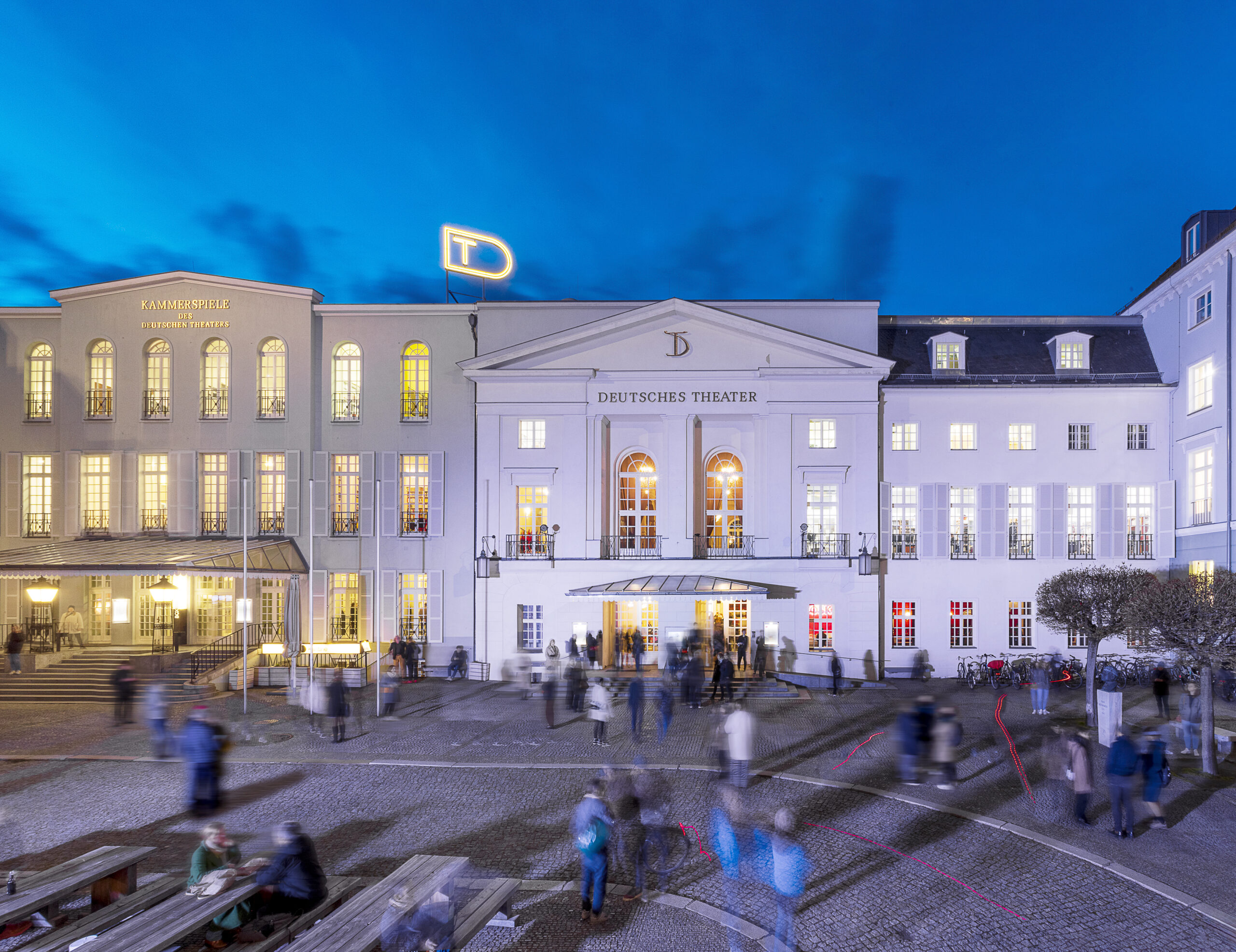
Deutsches Theater is one of the largest theatres in the German-speaking world. Situated in the centre of Berlin, it was built in 1848 as a commercial theatre, but only one generation later, under a new management and the name “Deutsches Theater” (German Theatre), it had developed to become one of the most significant and influential theatres in the world – a status which it still holds today. For more than 150 years, numerous actors, directors, playwrights… as well as technical innovations (like the invention of a revolving stage, the use of electricity, light design, up until video design and digital technologies) pushed the artistic means of the theatre medium further.
Today, with an ensemble of 38 actors, around 300 permanent employees, a repertoire of roughly 60 shows on re-runs as well as 20 new productions each season, Deutsches Theater is a powerful producing theatre.
The theatre has three stages (the large stage with approx. 650 seats, the Kammer with approx. 230 seats and the Box, a variable venue with a maximum of 80 seats) and some off-spaces like rehearsal stages, beautiful foyers for smaller events etc. In the season 2023/2024, Deutsches Theater welcomed close to 160.000 spectators in around 800 events throughout the year.
Since summer 2023, Iris Laufenberg has taken over the artistic direction of Deutsches Theater Berlin with her team. Her artistic project centres around opening up Deutsches Theater to new audiences, new artists, new texts and playwrights, while highlighting the DNA of this house: a sociopolitical approach to theatre, a profound interest in topics for a contemporary, international, metropolitan audience as well as a strong focus on its first-class ensemble of actors.
Deutsches Theater has long had a strong focus on contemporary drama and authors, with the staging of new theatre texts every season, the ‘Autor:innentheatertage’ (ATT), its annual playwrights’ festival for contemporary German drama, which will have its 30th edition in 2025, and the “ATT Ateliers”, offering three playwrights in-house writing residencies each season.
In addition, ‘DT Kontext’, with a free supporting programme of expert talks and discussions with our audiences for all productions, as well as ‘DT Jung*’, the youth and participatory department of the theatre, anchor Deutsches Theater as an important democratic public space in Berlin.
Deutsches Theater sees itself as a space to collectively encounter the present and explore its complexities.
Working with German and international stage directors such as Anita Vulesica, Sam Max, Claudia Bossard, Christopher Rüping, Anica Tomić, Alexander Eisenach, András Dömötör or Pınar Karabulut, the wide range of aesthetics and narrative styles presented at Deutsches Theater over a season, the multiple layers of discourse, the uniquely sensory experience of a theatre visit all offer a multiplicity of access points to our shared reality.
-
[All seats reserved / Tax included]
S Reserve JPY 6,000
A Reserve JPY 4,500
U29 (S Reserve) JPY 3,500
U29 (A Reserve) JPY 2,500
U18 (S / A Reserve) JPY 1,000
Discount for Persons with Disabilities 10% discount from adult prices
*Children below school age will not be admitted.
*The performance is recommended for ages 13 and older.
* Tickets with age-based discounts are available in advance only through the Tokyo Metropolitan Theatre Box Office (limited quantities available; valid ID required on the day of the performance).
* We cannot provide a refund for the difference if you are eligible for an age discount but you purchase a general admission ticket. In addition, if you purchase a discounted ticket that you are not eligible for, then you will be asked to pay the difference at the reception counter on the day of the performance.
* Visitors with a Disability Certificate or Mirairo ID can get tickets at a discounted price. Please check with the box office or the official website and check “Hello and Welcome (Attendee Support)” (https://autumnmeteorite.jp/en/2026/hello_and_welcome).
* Please contact the Box Office (0570-010-296) before purchasing a ticket if you are a wheelchair user as there is limited space within our venue.
* A hearing loop (magnetic loop) is available for some audience seats in this performance.
* Performance information and other details may be subject to change due to unavoidable circumstances.
* The reserving, buying or reselling of tickets for commercial purposes is strictly prohibited.
* We do not accept cancellations or changes once tickets have been purchased. This excludes where a performance is cancelled.
* Please be sure to check for the latest information on the official website before attending.
-
For children aged from 3 months old to pre-elementary age Admission fee/Capacity system/Advance reservation required (at least one week before the date of the performance) Asuka Incorporated Company Phone: 0120-165-115 (Weekdays 9:00 to 17:00)
-
Tokyo Metropolitan Theatre Box Office
0570-010-296 (10:00 to 19:00 excluding days when it is closed)
- Produced by Schauspielhaus Zürich
- Deutsches Theater Berlin
- Supported by
- The German Federal Foreign Office
- Co-operated by
- Goethe-Institut Tokyo
- Under the Auspices
- The Embassy of the Federal Republic of Germany in Japan
- Thanks to
- Takehiko Tanioka